


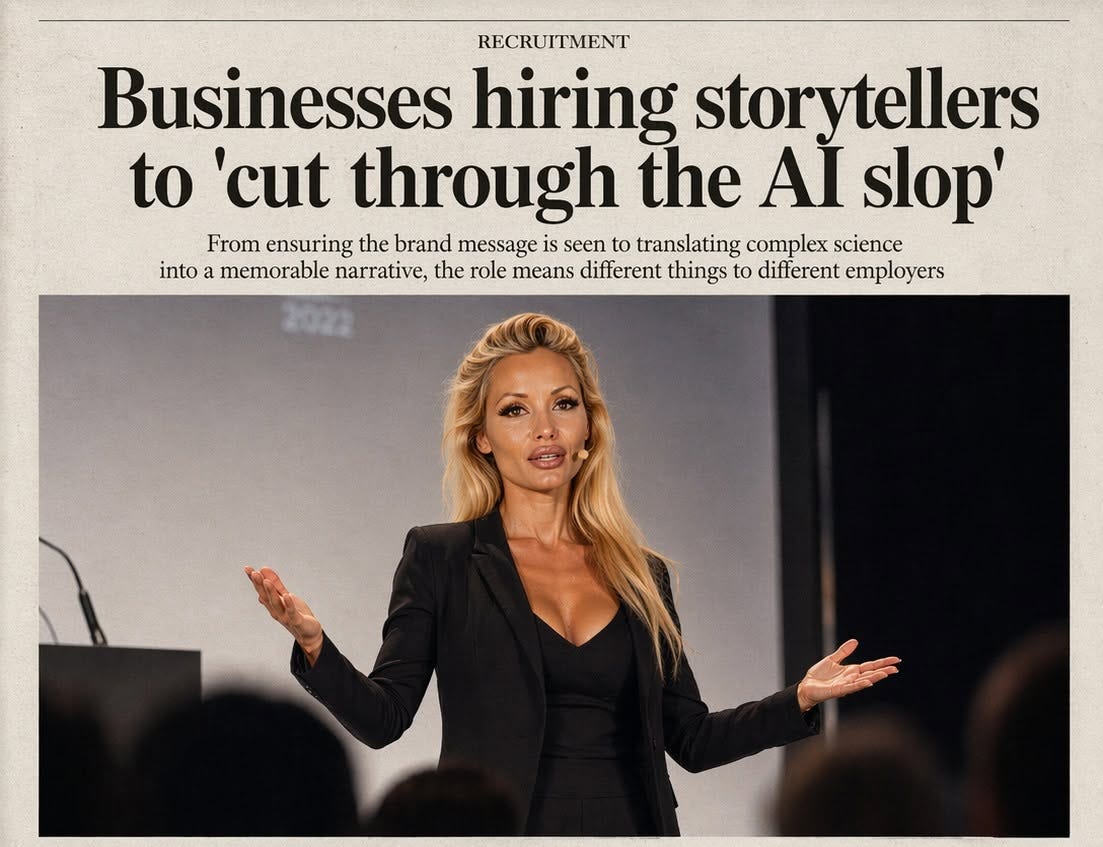
You can sniff out bad storytelling in two seconds. It’s clear who’s using AI to write, and you know it the minute you see it.
AI has a structure that is synthetic and inauthentic. It’s obvious. It’s bad storytelling.
To have any chance of penetrating through the AI slop, you need to create truly exceptional content. That’s why tech companies are hiring writers who can tell differentiated stories that sound NOTHING like AI and break through the noise.
AI writes to be useful. The human author writes to be visceral.
“Useful” writing is now a free commodity.
It’s forgettable.
And it’s everywhere.
“Visceral” writing— the kind that stops a scroll, the kind that lingers, the kind that comes from lived experience and human insight — is now a high-value asset.
And guess what? Visceral writing is the kind machines CANNOT reverse-engineer.
And that’s why:
The number of job postings mentioning ‘storyteller’ doubled last year — 50,000 in marketing, 20,000 in media and comms
Netflix opened up a tech comms role that pays $775,000 and OpenAI and Anthropic are paying up to half a million dollars in total comp for content and comms roles
GAP is hiring Chief Entertainment Officers to develop original shows
Andreessen Horowitz launched its New Media team to turn their founders into storytellers and “win the narrative battle online.”
Tech is often a leading indicator of what we see in other industries. Tech companies have adopted AI quickly, but they’re also quick to see the downside of the technology—that producing generic AI content is useless.
And so, they’re pivoting.
Storytelling is now a CEO-level initiative. The people who can sit next to the CEO, craft the narrative, and build the system that spreads it across the org... those are the people getting paid.
In a competitive market, a founder who is a “storyteller” has a massive advantage.
The floor has been raised for everyone.
But the ceiling still belongs to HUMANS.