


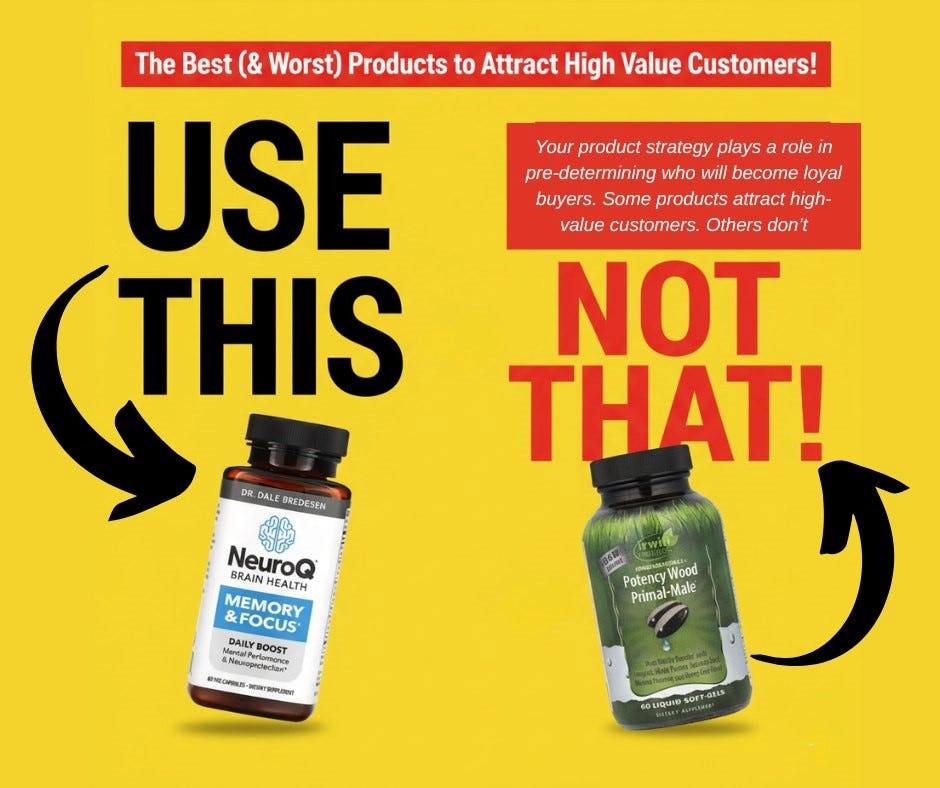
What’s the incremental value of each product that you create?
Are you even calculating this metric?
The items we sell help dictate how the customer will behave in the future.
In our vertical, certain product categories, like male potency, have notoriously poor back ends. It’s a category that attracts low-value customers who have low lifetime values.
If an offer causes a customer to purchase less often in the future, you want to de-emphasize the item—because it produces customers who spend less in the future.
Here is what a product that generates value looks like:
One of my Superhits was a consistently strong acquisition performer and driver of new customers.
It was also a solid performer in terms of repeat buying (with 50% of first-time buyers repurchasing).
On average, these buyers spent $142 on their first purchase… and then sought out other, out-of-category items from the brand.
Here’s how those numbers broke down:
29% rebought the original product only
30% rebought the original product plus something different
41% repurchased something different
So, 71% of the repurchasers are grazing from a larger assortment.
Why does this matter?
Because multiple category buyers tend to be more loyal/valuable.
Those additional items were purchases that wouldn’t have otherwise happened, incremental to the customer and to the business.
The *right* products can impact two important aspects of our customer file:
The number of new customers
The quality of customers
Looking at your business, are there certain categories that cause customers to migrate to other categories?
Is the downstream spend (and repurchase) better in certain acquisition categories?
When you are running the right merchandising analyses, you will understand how winning products and categories “cause” customers to be more valuable… which causes a ton of profit to be generated.
And this strategy applies to channels and content too.
So make sure you are developing products and content that cause customers to spend more (not less) in the future.