


We’ve built an entire generation of ecom businesses around 𝘳𝘦𝘯𝘵𝘪𝘯𝘨 𝘢𝘵𝘵𝘦𝘯𝘵𝘪𝘰𝘯.
But what happens when The Landlords raise the rent?
When you rent attention, you are completely at the mercy of the platforms that own the audience.
For example, Meta CPMs are up nearly 25% year over year. Up +125% since 2019.
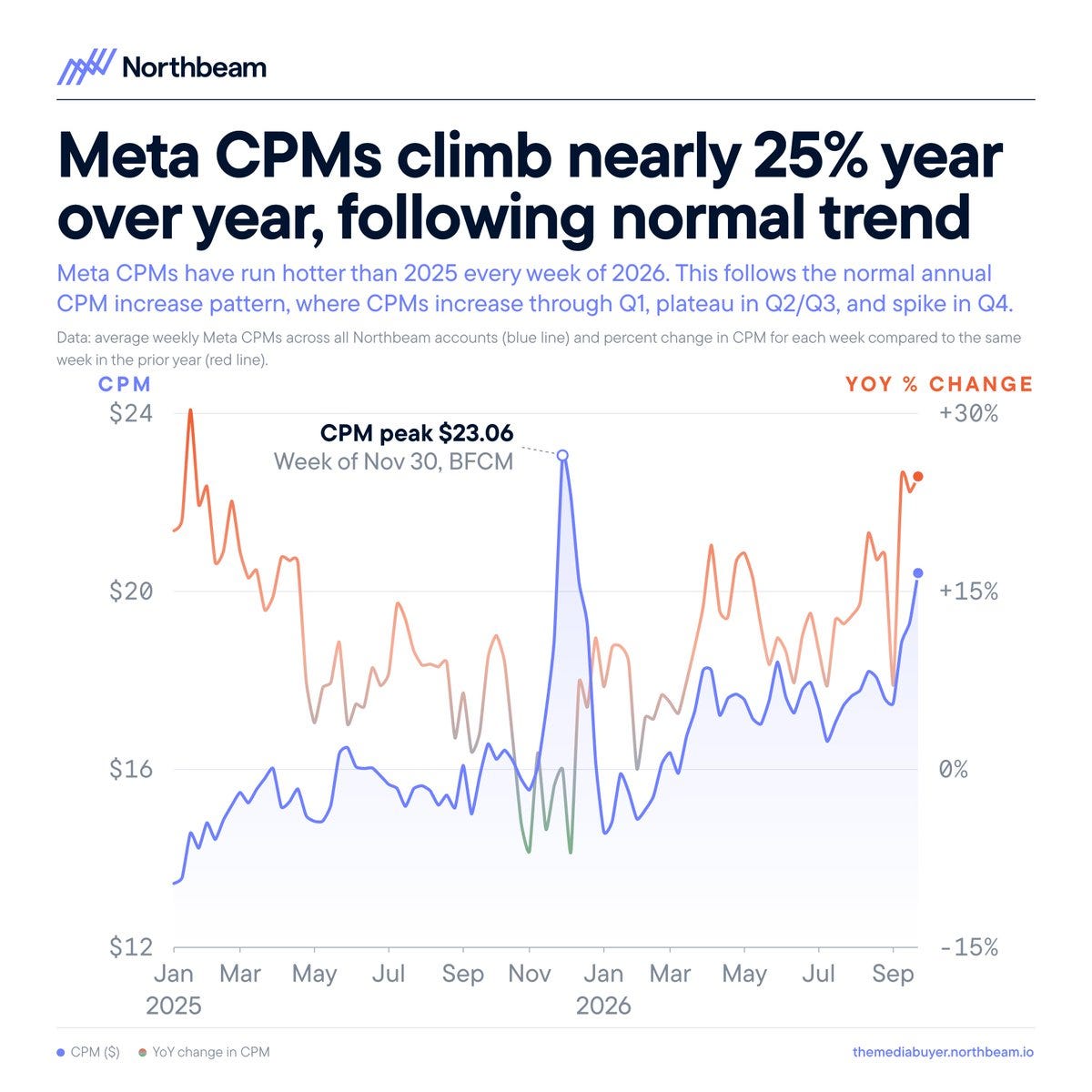
Here’s the part that should bother marketers: Meta’s daily active audience grew just 3% , while ad impressions increased 14%.
And the average price per ad still rose 12%.
That’s not scarcity. That’s more ad dollars chasing the same eyeballs. Supply went up. Prices went up anyway.
Sure, better creative helps. Better offers help. Better conversion rates help.
But none of those fundamentally solves the problem of depending on an increasingly expensive distribution channel you don’t control.
When a marketing channel begins to decay, you will see the costs within the channel disconnect from the reality of the channel. Advertisers who can’t make the math work spend less. Service providers, needing to hold revenue, charge more.
Round and round.
If you believe this story doesn’t end well, trust your instincts.
This will continue to play out for ecommerce brands over the next decade, once the AI bubble pops and newer AI-centric business models emerge from the rubble.
And there’s another problem. Consumers are exhausted by the relentless barrage of advertising.
WGSN is calling 2026 the “year of great exhaustion,” with a renewed emphasis on entertainment, human connection and what it calls “slow advertising.”
So we’re paying more to reach people who increasingly don’t want to be interrupted in the first place.
𝗪𝗲’𝗿𝗲 𝗶𝗻 𝗮𝗻 𝗮𝗿𝗺𝘀 𝗿𝗮𝗰𝗲 𝗳𝗼𝗿 𝗮𝘁𝘁𝗲𝗻𝘁𝗶𝗼𝗻.
Everyone bidding on the same strangers, on someone else’s property.
Of course, so long as the fight for consumer eyeballs remains cutthroat, brands will continue to push creative limits. More brands are using entertainment-led content to win attention.

But better content aimed at rented attention is still rented attention.
The brands with the greatest long-term advantage will be the ones that build and own their own distribution rather than continually renting someone else’s.
Brands that become media properties in their own right.
Brands that create content people actually want to consume.
Brands that generate organic demand, earn visibility in AI-driven discovery, and develop direct relationships through email, SMS and community.
And we’re already seeing what this looks like.

Dr. Eric Berg has built more than 48 million subscribers across his YouTube channels. And he sells supplements.
Think about the advantage that creates.
Every video is an opportunity to introduce his brand, educate prospective customers, promote products, capture email subscribers, and bring people into his commercial ecosystem.
He can retarget eligible viewers. He can make offers to people already familiar with his content. And when he launches a new product, he has an enormous audience to introduce it to.
He doesn’t need to start from zero every time he wants to sell something.
Here’s another example:
Headphones.com has a community of more than 500,000 registered users. Half a million people who raised their hand and said, audio gear, that’s me.
That’s your prospect list right there.
And you know exactly what prospects are interested in by observing the content they interact with on your site.
That’s data you can act upon with automated emails and texts featuring products and content relevant to each person’s interests.
The more valuable content you create, the more people you attract. Some become subscribers, community members, and customers.
This is what I mean when I talk about building your own distribution.
It’s a system that turns attention into revenue, and relationships that compound instead of resetting every time the auction ends.
All of that represents modern e-commerce.
Or… you can continue to rent temporary access to your own customers and prospects, enriching Google/Meta in the process.
You have choices.
Paid media will still have an important role. But it should amplify demand, not be the only way a brand can generate it.
I get blank stares when encouraging people to find a way off Meta. It’s just astounding.
These numbers are humbling. They should force you to address your personal marketing belief system.
It’s been my experience that not many professionals want to.