



The more of your message someone consumes, the better that ad works.
But we have a big problem…
We live in an age of extreme ad avoidance.
It’s why we fast-forward through commercials or scroll our phones until the show comes back.
It’s why we scroll right past an ad in our feed.
It’s why emails land in the Promotions folder.
We are so ad weary that most of us now ask AI our question instead of Google (because search results overflow with ads).
We seem to be telling marketers everywhere, “Please, go away! Get out of my face!”
‘Ad avoidance’ drives the attention problem
“Unexpected” creative is a good start to capturing low attention.

But even amazing creative is not a complete solution.
Here’s what the research shows. Professor Karen Nelson-Field studied 130,000 digital ad views, and 85% never earned the 2.5 seconds of active attention needed to register in memory.
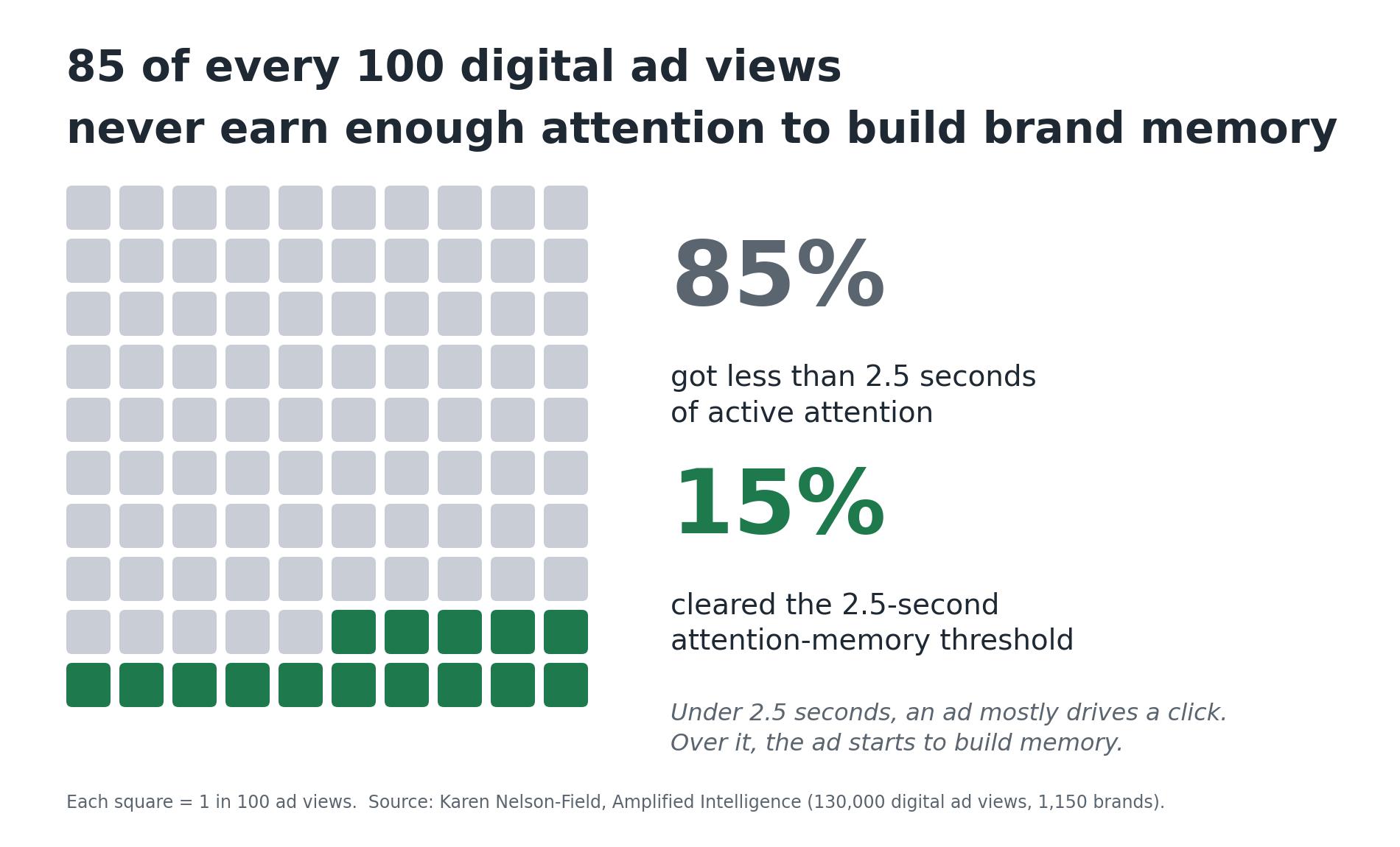
Because ad memory starts to kick in at 2.5 seconds, most ad views do little to build mental availability (the odds buyers think of you when it’s time to buy).
The interruption model is getting weaker
Roughly 80 to 90% of views in social feeds (Facebook, Instagram) never make it past one to two seconds, thanks to rapid scrolling.
Why does that matter? Because the more seconds of active attention an ad earns, the more days it stays in memory, and the longer it works for you.
But when ads don’t meet the 2.5 second threshold, they are only doing one thing: driving clicks.
As Nelson-Field told Informa TechTarget’s B2B demand gen summit, “… attention is the gateway to memory, mental availability, and ultimately, trust.” No trust, no shortlist.
Media sets the ceiling on creative
Here’s the finding that stings. The platform sets the ceiling on attention, and creative works inside that ceiling.
Marketers love to preach that a creative or funny enough ad will make people stop and watch. Nelson-Field’s eye-tracking and facial-coding research shows that’s wrong.
On low-attention, fast-decay platforms, creative can’t force anyone to keep watching. Its job is to make the most of the 1.5 to 2 seconds you get.
Nelson-Field and Peter Field’s Cost of Dull Media research puts the impact split at roughly 70% media and 30% creative.
Their term for low-attention formats where ads go largely unseen is “dull media.”
So can amazing creative crack fleeting attention? Not alone.
That means the old interruption model is getting weaker. The real opportunity is to create marketing people willingly consume and engage with.
That’s one reason I’m so interested in organic YouTube and other high-attention formats. They let you create marketing that doesn’t feel like advertising.
When your content is valuable, entertaining, and speaks directly to the heart of your market, people choose to consume it.
The shift from social platforms to creator-driven entertainment platforms is opening even more creative doors.
Take Progressive’s “You Are Not Your Parents” faux podcast. It’s brand-as-entertainment content marketing at its best.
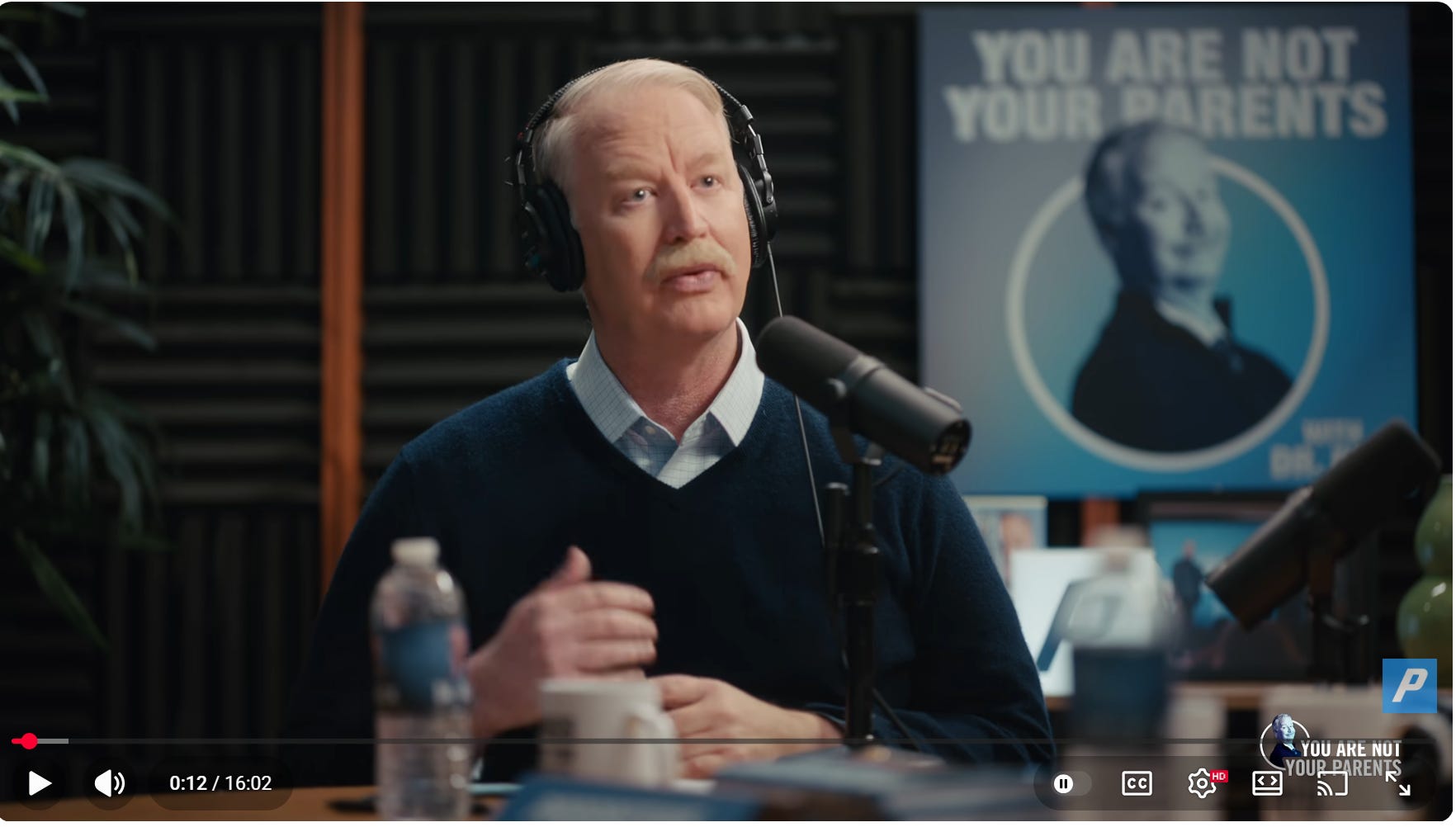
Progressive skipped the traditional 30-second spot pushing home insurance rates. Instead, it built a full 16-minute faux YouTube podcast starring Dr. Rick, its recurring ad character. The whole thing runs on earned engagement and character affinity.
Cultural relevance
Progressive didn’t BUY attention. It earned it.
Sure, years of paid TV spots built Dr. Rick. That’s the point: media built the character, and now the character earns the attention.
Ana Andjelic, sociologist and author of Hitmakers, argues that brands make culture through five mechanisms: repetition, mobility, immutability, aggregation, and organization. Culture’s raw materials include vocabulary, media, and shared habits. Dr. Rick works with all three.
Here’s how the podcast turns a character into culture:
Creates the Dr. Rick persona: Dr. Rick is a deadpan, no-nonsense life coach with one job, calling out grown adults who turn into their parents. He never sounds like an insurance spokesperson. He speaks in dry behavioral coaching jargon, and you almost forget who’s paying for the show.
Invents a lexicon: Progressive gave everyday adulting habits a clinical name, “Parentamorphosis,” and then added “parental triggers.” Give people a word for something they already do, and they start using it.
Writes quotable lines: The script skips slogans and hands you hyper-specific rules for living. Rules you can repeat at dinner:
“When not in use, kill the juice.”
“Unless you’re waiting for an important call while jumping on a trampoline, there’s no reason to clip your phone onto your belt.”
Hijacks the podcast format: Progressive borrows the format everyone already watches, the behind-the-mic studio video podcast made famous by Rogan, Call Her Daddy, and Huberman. Same setup. Zero insurance pitch.
Relinquishes the meme: Progressive builds the premise, then lets go. Viewers share clips across their feeds and tag friends or spouses with comments like “This is literally you.” When the audience owns the joke, they do the distribution for you.
Zero hard sell
The Dr. Rick video barely mentions quotes, premiums, or coverage. Some of you will say that’s pointless. Little to no ROI. Useless.
But that’s the point. Comedic storytelling builds goodwill, high watch time, and top-of-mind recall.
The video sits at roughly 245,000 organic views and over 2,100 likes. For a 16-minute, unpromoted corporate upload, that’s strong.
The goal is unaided brand recall. So when your viewers finally need insurance, they search for “Progressive” instead of “cheap insurance.”
High attention isn’t just a screen thing
One reason I still love direct mail: its storytelling capability is very high.
Nobody flips through a 32-page magalog in a few seconds.
Someone who opens one sits down with it. They read the story, the science, and the proof, and they spend time consuming your message instead of a thumb-flick.
And the beauty of that is that the customer who reads a 32-page Magalog (or watches a 10–20-minute video) ends up more engaged, more informed and with a higher LTV than someone who watches a reel for a few seconds.
At a direct-response supplement company I worked for, average customer LTV topped $1,200 built on magalogs plus a serious retention program.
The bottom line
The data is sobering. 85% of digital ad views never reach the 2.5 seconds it takes to build memory, and even your best headline won’t change that math.
In the attention economy and the AI era, success means understanding how attention plays out between platforms, and adjusting media strategy and creative accordingly.
Over and over again, the data shows that media doesn’t just deliver the message. It decides whether anyone sees it.
So stop fighting for the interruption. Put your media where people actually look.
So here’s your challenge. Ask your team what you can create that your market will choose to watch, quote, and share. Progressive did it with a deadpan life coach and a joke the audience owns.
And then go build it.