


Your agency optimizes the campaign. But who optimizes the customer?
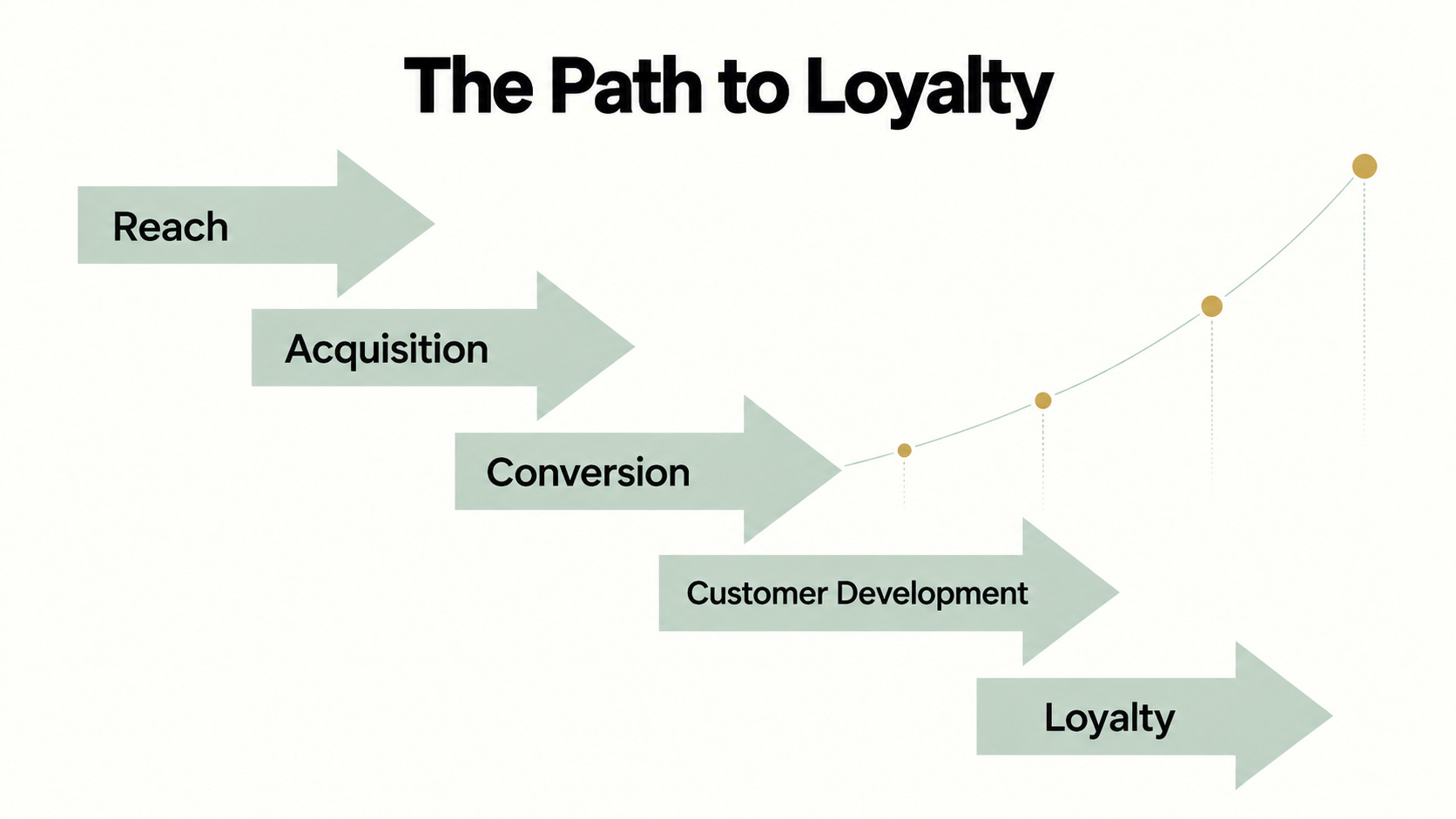
It’s REALLY important to understand the process of developing customers from prospects to loyal buyers and take action to move customers through the process 𝘲𝘶𝘪𝘤𝘬𝘭𝘺.
Why? Because customer development drives loyalty and profit. So, it’s critical to have an ascension strategy.
== 𝗧𝗵𝗲 𝗥𝗢𝗔𝗦 𝗧𝗿𝗮𝗽 ==
Most businesses only seek to generate sufficient ROAS on efforts. This guarantees profit on individual campaigns—that’s halfway toward an actionable outcome.
Does it guarantee profit over time, and yield a healthy brand?
Absolutely not.
All businesses should work diligently to accelerate repurchase and extend customer lifespan. But hey, you won’t hear that from your agencies. (Vendors have an entire ecosystem designed to nudge you down the path that is most beneficial to the vendor business model.)
ROAS tells you whether you acquired the customer efficiently. It doesn’t tell you whether you developed that customer profitably. And the period immediately following that first sale is where much of that value is won or lost.
== 𝗧𝗵𝗲 𝗪𝗲𝗹𝗰𝗼𝗺𝗲 𝗪𝗶𝗻𝗱𝗼𝘄: 𝗬𝗼𝘂𝗿 𝟴-𝟭𝟮 𝗪𝗲𝗲𝗸 𝗢𝗽𝗽𝗼𝗿𝘁𝘂𝗻𝗶𝘁𝘆 ==
The most important stage in the customer journey is the first 8-12 weeks following a first purchase. This window is far more important than any loyalty efforts you might implement.
Customers who purchased 15 days ago are much more likely to repurchase than customers at 90 or 120 days. And the probability of buying increases with each additional purchase.
So, your goal is to work diligently to move a customer from 1x to 2x and 2x to 3x so that *some* customers enter the loyalty stage.
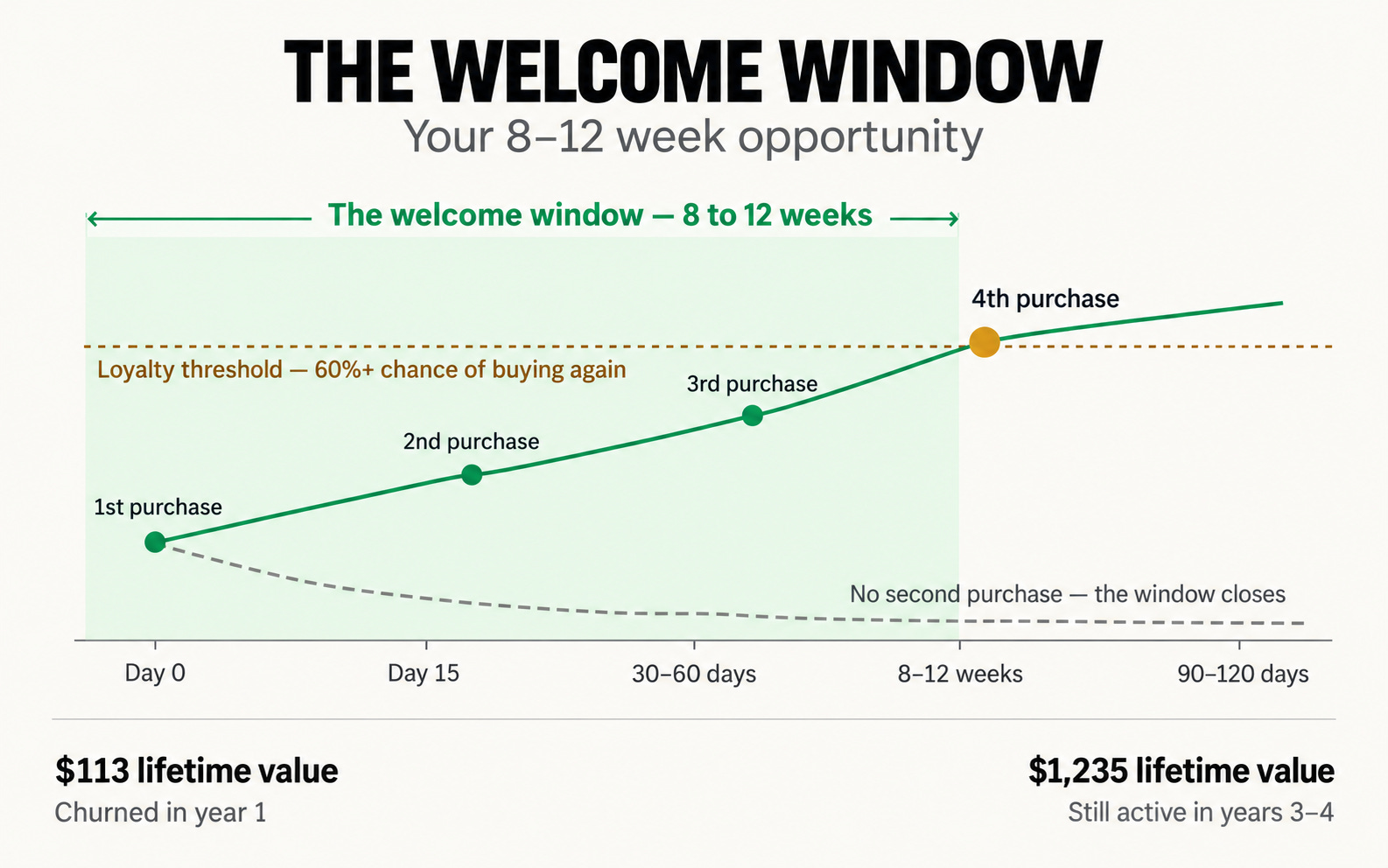
This typically happens after a 4th purchase, when a customer has a 60% or greater chance of purchasing again. That’s the loyalty threshold. Yet most businesses completely squander the welcome stage.
Meanwhile the window to establish a profitable relationship closes.
The more quickly you convert a new customer to a second purchase, the more likely you are of generating profit from the customer over time.
That’s why the smartest companies I work with go “all-in” on converting the first time buyer from a first purchase to a second purchase. They send welcome videos. They ask you to watch an educational video on YouTube. They leverage their email streams. They reach out to customers by phone to see how the item is working out for them. Some share best sellers helping them to cross-purchase in different categories.
This is the period where you can make the BIGGEST difference in the trajectory of your relationship with the customer. And the only realistic chance to convert the customer.
But there needs to be a strong program in place to quickly convert the first-time buyer to a second order, and almost nobody puts in the effort to do this.
One analysis showed lifetime revenue for customers active three to four years was over ten times higher than customers who churned in year one. $1,235 versus $113 in lifetime value.
As marketers, we have an opportunity to develop customers, moving them through the stages of customer development toward loyalty. If you’re not developing customers you are squandering the enormous opportunity.
== 𝗘𝗺𝗮𝗶𝗹 𝗦𝗵𝗼𝘂𝗹𝗱 𝗕𝗲 𝗬𝗼𝘂𝗿 𝗣𝗿𝗶𝗺𝗮𝗿𝘆 𝗥𝗲𝗹𝗮𝘁𝗶𝗼𝗻𝘀𝗵𝗶𝗽 𝗩𝗲𝗵𝗶𝗰𝗹𝗲 ==
Email marketing should be your primary vehicle for having a relationship with your customer.
Email should generate 30-40% of sales. It’s your best channel for nurturing customers through development stages.
But don’t overlook fulfillment box inserts, outbound calls, and direct mail. These channels deliver surprisingly strong response when deployed strategically.
== 𝗙𝗲𝗲𝗱 𝘁𝗵𝗲 𝗙𝘂𝗻𝗻𝗲𝗹 𝗕𝗲𝗳𝗼𝗿𝗲 𝘁𝗵𝗲 𝗦𝗮𝗹𝗲 ==
Developing customers starts well before the sale. Unless you are a startup, you should have feeder programs that create awareness and nurture your customers on a path to a sale. (Paid advertising is not a feeder program.)
Is there a doctor or influencer who can’t stop talking about your product?
A YouTube channel or website dedicated to educating customers?
Blog posts?
Podcasts?
Are you familiar with Life Extension? They have been doing ‘Feeder programs’ for years with their free magazine. Building authority and trust before the sale happens.
Psst…You're actually reading one right now. Substack is a feeder program.
The point is that customer development isn’t a tactic. It’s a relationship strategy. One that begins long before the sale, accelerates immediately after it, and deepens with every interaction and purchase.
And that requires a different way of thinking about where customer value is actually created.
Most brands work relentlessly to improve the economics of acquisition. Far fewer bring that same discipline to what happens after the sale.
Getting the first order is only the beginning. The real opportunity is to move that customer from purchase #1 to #2, from #2 to #3, and ultimately toward loyalty.
Build the feeder programs. Build the welcome sequence. Give customers reasons to learn, to engage, to be entertained and buy again.
The difference between a low-value customer and a high-value customer isn’t just who you acquire. It’s whether you “develop” them once they arrive.
.